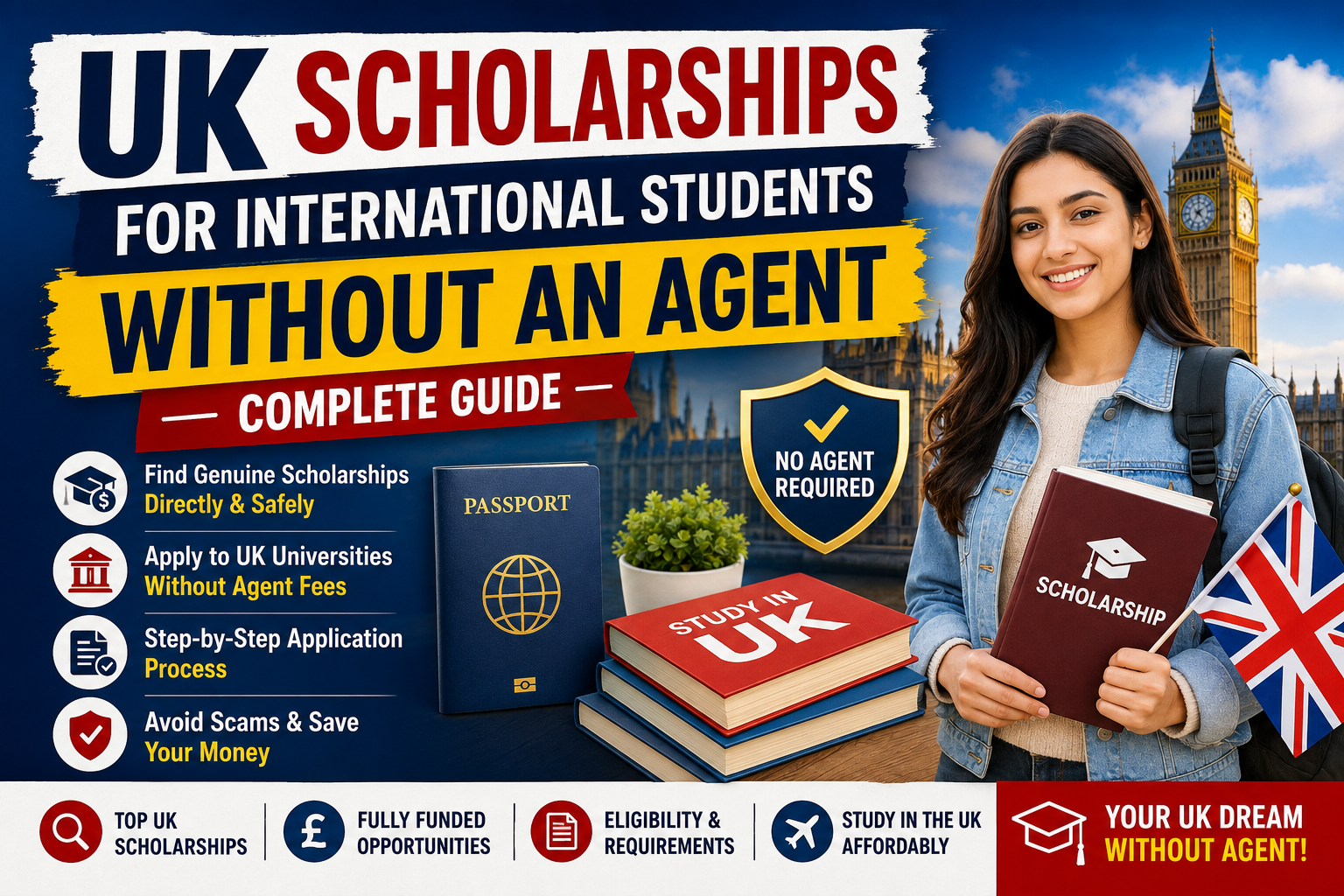
UK Scholarships for International Students Without an Agent Complete Guide
Studying in the United Kingdom is a goal for thousands of international students every year. However, many students believe they cannot apply to a UK university or scholarship without paying an education agent. This belief often comes from confusing application processes, complicated university websites, and the fear of making mistakes in important documents.
The reality is that many students can research UK universities, find scholarships, submit applications, and prepare their visa applications independently. An agent may be helpful in some situations, but using one is not automatically required for every international student. In many cases, the official university, scholarship, and UK government websites provide the information applicants need to complete the process themselves.
This guide explains how to find UK scholarships without an agent, where to search for legitimate funding, how to apply directly, which documents you may need, how to avoid scholarship scams, and how to decide whether you actually need professional help.
If you are searching for verified scholarships, internships, jobs, and other international opportunities, Energie Intelligent helps students and fresh graduates find useful career and education information in one place. The platform is designed to make opportunity research easier by sharing practical guides and updated listings that help users understand where and how to apply.
Can International Students Apply for UK Scholarships Without an Agent?
Yes, many international students can apply for UK scholarships without using an education agent.
The exact process depends on the scholarship. Some scholarships require applicants to apply directly through the official scholarship website. Others require students to apply to a university first and then complete a separate scholarship application. Some university scholarships may automatically consider students after they submit an admission application.
There is no single application process for every UK scholarship.
For example, the Chevening Scholarship has its own official application process, while the GREAT Scholarships are offered through participating universities and have country-specific information. Commonwealth Scholarships also have their own application procedures and eligibility rules. (Chevening)
This means the most important skill is not finding an agent. It is learning how to identify the correct official source and follow the instructions carefully.
Why Do Students Want to Apply Without an Agent?
Many international students choose to apply independently for several reasons.
1. Agents Can Be Expensive
Some education agents charge service fees for:
- University applications
- Scholarship applications
- Document preparation
- Visa assistance
- Accommodation support
The cost varies from one agent to another.
Some agents may offer free services because they receive commissions from universities, while others charge students directly. Before signing any agreement, students should understand exactly what they are paying for.
2. Students Want More Control
When you apply yourself, you can:
- Choose your own universities
- Read the exact admission requirements
- Compare scholarship terms
- Submit your own personal statement
- Track your application
- Communicate directly with university staff
This can give you a better understanding of your own application.
3. Not Every Agent Is Reliable
Most education agents may be trying to provide a legitimate service, but students should still be careful.
A dishonest agent might:
- Promise guaranteed admission
- Promise a guaranteed scholarship
- Submit false information
- Recommend universities based only on commission
- Ask for unnecessary payments
- Use unofficial scholarship information
No legitimate person can guarantee that a student will receive a highly competitive scholarship.
4. Official Information Is Available Online
Universities publish admission requirements on their websites. Government scholarship programs also publish their own eligibility rules and application instructions.
For example, the UK government provides information about major international postgraduate scholarship programs, including Chevening and Commonwealth Scholarships. (GOV.UK)
The key is to use the official source instead of depending only on social media posts or third-party claims.
What Is the Difference Between a University Agent and a Scholarship Agent?
Students often use the word “agent” for different types of services.
University Education Agent
A university education agent may help students:
- Select universities
- Submit admission applications
- Prepare documents
- Communicate with universities
Some universities work with official representatives.
Scholarship Consultant
A scholarship consultant may help with:
- Scholarship searches
- Personal statements
- Application reviews
- Interview preparation
Immigration Adviser
An immigration adviser may provide immigration-related assistance. Immigration advice can be regulated, so students should be careful when paying anyone for visa advice.
You do not necessarily need all of these services. A student may be able to complete a university application independently and use official UK government information for the visa process.
How to Find Genuine UK Scholarships Without an Agent
The best way to find a genuine scholarship is to begin with reliable sources.
1. Official UK Government Websites
The UK government provides information about major scholarship programs for international students.
Government-funded opportunities can include support for:
- Tuition fees
- Living expenses
- Travel
- Other study-related costs
However, the exact coverage depends on the scholarship.
For postgraduate students, the UK government highlights programs such as Chevening and Commonwealth Scholarships. Each program has separate eligibility requirements and application procedures. (GOV.UK)
2. Official Scholarship Websites
Always look for the official website of the scholarship.
For example, Chevening provides its own eligibility information, application guidance, course requirements, and application timeline. Applicants should use the official application system rather than paying an unknown person to submit an application on their behalf. (Chevening)
3. University Websites
Many UK universities offer scholarships directly to international students.
To find them, visit the university’s official website and search for terms such as:
- International scholarships
- Scholarships for overseas students
- Funding opportunities
- Postgraduate scholarships
- Undergraduate scholarships
- Country-specific scholarships
University scholarship pages normally explain:
- Eligibility
- Award value
- Application deadline
- Required documents
- Application method
4. British Council Study UK
The British Council’s Study UK platform provides information about scholarships and funding opportunities.
One important example is the GREAT Scholarships program. For the 2026-27 academic year, the program offers scholarships through participating universities to students from a list of eligible countries, including Pakistan. The scholarship amount and participating institutions can vary, so applicants should check the official country-specific information. (Study UK)
Major UK Scholarships International Students Can Explore
The following scholarship categories are among the most important opportunities for international students.
Chevening Scholarships
Chevening is one of the best-known UK government-funded scholarship programs.
It supports outstanding professionals and future leaders who want to complete a one-year master’s degree in the UK.
The scholarship is highly competitive.
According to the official eligibility criteria, applicants generally need to:
- Be a citizen of an eligible country or territory
- Have at least two years of eligible work experience
- Hold an undergraduate degree that qualifies them for a UK master’s program
- Apply to three eligible UK university courses
- Receive an unconditional offer from at least one selected course by the relevant deadline
- Commit to returning to their country for at least two years after the scholarship ends (Chevening)
The application process is completed through the official Chevening system.
For the 2026-27 cycle, Chevening applications opened on 4 August 2026 and close on 6 October 2026 at 11:00 UTC, according to the published application timeline. Scholarship cycles change, so applicants should check the current timeline before applying. (Chevening)
What Does Chevening Cover?
The exact award package should always be checked in the official scholarship guidance. Chevening is generally described as a fully funded scholarship program for eligible one-year master’s study in the UK. (Chevening)
Can You Apply for Chevening Without an Agent?
Yes. Eligible applicants can apply through the official Chevening application process.
An agent cannot guarantee selection because applications are assessed according to the official criteria.
Commonwealth Scholarships
The Commonwealth Scholarship Commission manages several scholarship opportunities for eligible Commonwealth countries.
Commonwealth Master’s Scholarships are intended for talented candidates from eligible low- and middle-income Commonwealth countries who want to undertake full-time taught master’s study at a UK university.
The program focuses on development-related areas and has its own eligibility and application requirements. The official commission states that applications are submitted through the designated CSC application system and that applications or documents sent outside the official system are not accepted. (Commonwealth Scholarships UK)
This is a strong example of why students should always check official instructions before paying an agent.
If the official scholarship system accepts direct applications, a student should understand why an agent is being presented as mandatory.
GREAT Scholarships
GREAT Scholarships are offered through participating UK universities and are jointly funded by the UK government’s GREAT Britain Campaign, the British Council, and participating higher education institutions.
For the 2026-27 academic year, the program lists more than 140 scholarships across more than 60 universities in England, Wales, Scotland, and Northern Ireland. The scholarships provide £10,000 toward tuition fees for eligible one-year taught postgraduate courses, and the list of eligible countries includes Pakistan. (Study UK)
Students should check:
- Whether their country is eligible
- Which universities are participating
- Which courses are covered
- The application deadline
- Whether they must apply separately for university admission
The application method can differ by university.
University-Specific Scholarships
Many universities offer scholarships that are not connected to a major national program.
Examples may include:
- International excellence scholarships
- Vice-Chancellor scholarships
- Global achievement awards
- Country-specific scholarships
- Faculty scholarships
- Academic merit awards
The award may be:
- A fixed amount
- A tuition fee discount
- Partial tuition funding
- Full tuition funding
The word “scholarship” does not automatically mean that all expenses are covered.
Always check the exact award value.
How to Search for Scholarships Directly
A simple search strategy can help you avoid unnecessary dependence on agents.
Step 1: Decide Your Degree Level
First identify whether you want to study:
- Undergraduate degree
- Master’s degree
- PhD
- Research program
- Short course
Different scholarships have different requirements.
Step 2: Choose Your Subject
Write down your intended subject.
For example:
- Computer Science
- Business
- Engineering
- Public Health
- Data Science
- Education
- Economics
- Law
- Environmental Science
Your subject can help you find university departments and scholarships.
Step 3: Create a List of Universities
Search for UK universities offering your course.
Do not choose a university only because an agent recommends it.
Compare:
- Course content
- Entry requirements
- Tuition fees
- Location
- Scholarship opportunities
- Deadline
Step 4: Visit the Official University Website
Find the scholarship section.
Search for phrases such as:
University name + international scholarships
For example:
University name + international postgraduate scholarship
Always verify that the result belongs to the official university website.
Step 5: Check the Scholarship Eligibility
Read the eligibility rules carefully.
Check:
- Nationality
- Academic qualification
- GPA or grades
- English requirements
- Work experience
- Course requirements
- Deadline
Step 6: Check Whether You Need a Separate Application
Some scholarships are automatic.
This means the university may consider you automatically after you submit your admission application.
Other scholarships require:
- Separate form
- Personal statement
- Additional documents
- Scholarship essay
Do not assume that submitting an admission application automatically means you have applied for every scholarship.
How to Apply to a UK University Without an Agent
The process varies by university and degree level, but the general process is straightforward.
Step 1: Find the Official Course Page
Locate the exact program you want to study.
Check:
- Course duration
- Start date
- Tuition fees
- Entry requirements
- English language requirements
- Application deadline
Step 2: Prepare Your Documents
Common documents may include:
- Passport
- Academic transcripts
- Degree certificate
- CV
- Personal statement
- Recommendation letters
- English language proof
- Portfolio, where required
The exact requirements differ by program.
Step 3: Submit Your Application
Universities may use their own application portal or another official application system, depending on the course and institution.
Follow the instructions on the university website.
Step 4: Track Your Application
After applying, save:
- Application number
- Login details
- Email confirmations
- Deadline information
Create a simple spreadsheet to track your applications.
This can help you avoid missing important messages.
How to Apply for a UK Scholarship Without an Agent
A scholarship application usually requires careful preparation.
1. Read the Official Guidelines
Do not begin writing before understanding the rules.
Check:
- Word limits
- Required questions
- Document format
- Deadline
- Eligibility criteria
2. Write Your Own Personal Statement
Your personal statement should explain:
- Your background
- Your academic interests
- Your career goals
- Why you chose the UK
- Why you selected the specific program
- What you want to achieve after graduation
Do not copy a template from the internet and submit it without making it personal.
3. Use Specific Examples
Instead of writing:
I am a hardworking and passionate student.
Explain what you actually did.
For example:
- Led a university project
- Completed an internship
- Built a software application
- Volunteered in a community program
- Conducted research
- Worked on a professional project
Specific examples are more convincing than general claims.
4. Request Strong References
Choose people who know your academic or professional work.
A good reference should provide meaningful information about your:
- Skills
- Performance
- Character
- Leadership
- Potential
5. Proofread Everything
Check:
- Spelling
- Grammar
- Names
- Dates
- University names
- Course names
A simple mistake can create confusion.
How to Apply for a UK Student Visa Without an Agent
After receiving an admission offer and meeting the conditions, eligible students may need to apply for a Student visa.
The official UK government process requires applicants to apply online. Depending on the applicant’s circumstances and identity document, they may need to use the UK Immigration: ID Check app or attend a visa application centre to provide biometric information. (GOV.UK)
The general process includes:
- Receive an offer from a licensed student sponsor.
- Meet the conditions of the offer.
- Receive the required confirmation for visa purposes.
- Check the current Student visa requirements.
- Prepare the required documents.
- Complete the online application.
- Prove your identity.
- Provide biometrics if required.
- Pay the required fees.
- Wait for a decision.
The current visa rules can change, so applicants should always check the official GOV.UK guidance before submitting an application. (GOV.UK)
What Documents May Be Required for a UK Student Visa?
The exact documents depend on your circumstances.
Applicants may need documents such as:
- Valid passport
- Confirmation of Acceptance for Studies
- Proof of finances, when required
- Evidence of English language ability, where required
- Academic documents
- Tuberculosis test results, if required
- ATAS certificate for certain courses, if required
The official Student visa guidance explains that applicants should check which documents are needed for their individual application. (GOV.UK)
Do not rely only on an agent’s checklist because immigration requirements can change.
How to Avoid UK Scholarship Scams
Scholarship scams are one of the biggest concerns for international students.
Be Careful with Guaranteed Scholarships
No one should promise that you will definitely receive a highly competitive scholarship.
Selection depends on eligibility, application quality, competition, and the scholarship’s official process.
Be Careful with Fake Payment Requests
A suspicious person may ask you to pay:
- Scholarship registration fee
- Guaranteed selection fee
- Embassy approval fee
- Scholarship release fee
Always verify whether the payment is actually required by the official organization.
Check the Website Domain
Look carefully at the website.
Official government and university websites usually have recognizable domains.
However, students should not rely on the domain alone. Fake websites can sometimes look professional.
Check the scholarship information against the official organization.
Search for the Scholarship on the Official Website
If someone tells you about a scholarship, search for the same scholarship on:
- Official government website
- Official scholarship website
- Official university website
If you cannot find the scholarship anywhere official, be cautious.
Never Submit False Information
An agent may suggest:
- Changing your grades
- Hiding previous education
- Creating fake work experience
- Using false documents
Never do this.
False information can cause serious problems with admission and immigration applications.
Should You Use an Agent at All?
The answer depends on your situation.
You May Not Need an Agent If:
- You can read English instructions
- You can research universities
- You can prepare your own documents
- You can complete online forms
- You can communicate by email
- You can follow official visa instructions
Many students can manage these steps independently.
An Agent May Be Helpful If:
- You are confused about university choices
- You have a complicated academic history
- You need help understanding an application
- You need professional immigration advice
- You have difficulty completing online forms
However, you should still verify important information yourself.
Using an agent does not remove your responsibility for the information submitted in your name.
Questions to Ask an Education Agent Before Paying
If you decide to work with an agent, ask:
1. What services are included?
Get a written list.
2. How much will I pay?
Ask for a complete fee breakdown.
3. Are there additional charges?
Some services may be charged separately.
4. Which universities do you represent?
Ask for specific names.
5. Are you an official representative?
If the agent claims to represent a university, verify that information with the university.
6. What happens if my application is rejected?
Understand the refund policy.
7. Who owns my application account?
You should maintain access to your own email and application information.
How to Apply for UK Scholarships from Pakistan Without an Agent
Pakistani students can use the same basic research strategy.
Step 1: Choose Your Study Level
Decide whether you want:
- Bachelor’s degree
- Master’s degree
- PhD
Step 2: Research Scholarships Open to Pakistani Students
The GREAT Scholarships program is one example of a UK scholarship initiative that includes Pakistan among its eligible countries for the 2026-27 academic year. Applicants should review the current participating universities and course requirements. (Study UK)
Chevening also has country-specific eligibility and application information for eligible applicants. (Chevening)
Step 3: Prepare Your Academic Documents
Keep digital copies of:
- Matriculation certificate
- Intermediate certificate
- Bachelor’s degree
- Transcripts
- Passport
- English language documents
The exact documents required depend on the program.
Step 4: Apply Directly
Use:
- Official university application portals
- Official scholarship systems
- Official government websites
Avoid sending documents to unknown individuals.
Step 5: Track Every Deadline
Create a table with:
| Scholarship | University | Deadline | Documents | Status |
|---|---|---|---|---|
| Scholarship A | University A | Date | Complete | Submitted |
| Scholarship B | University B | Date | Missing reference | In progress |
This simple system can help you manage multiple applications.
Common Mistakes International Students Make
Mistake 1: Applying Only Because an Agent Recommended a University
Your university should match your:
- Academic background
- Career goals
- Budget
- Subject interest
Do your own research.
Mistake 2: Searching Only for “Fully Funded”
A partial scholarship can still reduce the total cost significantly.
You should search for:
- Tuition discounts
- Merit awards
- Department scholarships
- Research funding
- External funding
Mistake 3: Ignoring the Total Cost
A scholarship may cover tuition but not:
- Housing
- Food
- Visa
- Travel
- Insurance
Calculate the remaining cost before accepting an offer.
Mistake 4: Waiting Until the Last Week
Scholarship applications can require:
- References
- Essays
- Transcripts
- Language test results
Start early.
Mistake 5: Copying Someone Else’s Personal Statement
A copied statement can make your application sound generic and may create problems if it contains inaccurate information.
Write about your own experience.
How to Make Your Scholarship Application Stronger
Tell a Clear Story
Your application should explain:
- Where you come from
- What you have studied
- What you have done
- What you want to learn
- What you want to do afterward
Connect Your Course to Your Career
Explain why the chosen program matters to your future.
For example:
A student applying for a master’s degree in data science might explain how the program will help them develop skills to work on data-driven projects in their home country.
Show Evidence
Do not only say you are a leader.
Explain:
- What responsibility you had
- What action you took
- What result followed
This makes your application more credible.
Explain Your Future Plans
Many scholarships want to understand how your education will contribute to your future career and wider goals.
Your plans do not need to be unrealistic.
A clear, practical plan is often better than a vague promise to “change the world.”
UK Scholarships Without an Agent: A Simple Checklist
Before applying, ask yourself:
University Research
- Have I checked the official university website?
- Does the course match my academic background?
- Have I checked the entry requirements?
Scholarship Research
- Is the scholarship listed on an official source?
- Am I eligible by nationality?
- Does the scholarship cover tuition or living costs?
- Is a separate application required?
Application
- Are my documents complete?
- Is my personal statement original?
- Are my references ready?
- Have I checked the deadline?
Visa
- Have I checked the current GOV.UK Student visa requirements?
- Do I understand the financial requirements?
- Do I know which documents I need?
Is Applying Without an Agent Difficult?
At first, the process can seem difficult because there are many steps.
However, once you divide the process into smaller tasks, it becomes more manageable.
You can think of the process in five stages:
Stage 1: Research
Find the university and scholarship.
Stage 2: Check Eligibility
Confirm that you meet the requirements.
Stage 3: Prepare Documents
Organize your academic and personal documents.
Stage 4: Apply
Submit the application through the correct official system.
Stage 5: Follow Up
Track your application and respond to official emails.
The biggest challenge is usually not the application form itself. It is understanding the requirements and meeting deadlines.
How Energie Intelligent Can Help Students
Many students do not need someone to submit every form for them. What they often need is clear information.
Energie Intelligent is a career and education platform that helps students and professionals discover:
- International scholarships
- Jobs
- Internships
- Courses
- Career guides
- MTO opportunities
- Study opportunities
The purpose is to make opportunity research easier by sharing information in one place.
For students searching for UK scholarships without an agent, a useful approach is to use career platforms for discovery and then verify the final information through the official university, scholarship, or government source.
This is an important distinction.
A platform can help you find an opportunity, but the official organization should be your final source for eligibility, deadlines, application procedures, and funding details.
Final Conclusion
Applying for UK scholarships without an agent is possible for many international students. The process requires research, organization, careful document preparation, and attention to official instructions. You do not need to depend completely on an agent to find a university, search for scholarships, submit applications, or understand the basic Student visa process.
The safest approach is to begin with official sources. Search for scholarships through government websites, official scholarship organizations, the British Council’s Study UK resources, and individual university websites. After finding an opportunity, check the eligibility requirements, funding details, deadline, and application method directly from the organization offering the scholarship.
Major opportunities such as Chevening, Commonwealth Scholarships, GREAT Scholarships, and university-specific awards all have different rules. A scholarship that is suitable for one student may not be suitable for another. Some require professional experience, some are limited to certain countries, and some are available only for specific courses or degree levels. (Chevening)
The most important lesson is simple: do not pay someone merely because they claim that you cannot apply without them. First check the official application process. If the scholarship or university accepts direct applications, you may be able to apply yourself.
An agent can sometimes provide useful support, especially when an applicant has a complicated situation or needs professional assistance. But students should always understand what they are paying for, keep control of their own application information, and verify important advice through official sources.
For students in Pakistan and other countries who want to study in the UK, the process may feel complicated at first. However, with a clear plan, a document checklist, a deadline tracker, and reliable information, applying independently becomes much more realistic.
Start by choosing your course. Then find suitable universities. Check the official requirements. Search for scholarships. Prepare your documents. Apply through the correct system. Finally, verify the visa process through the official UK government website.
For scholarship updates, international jobs, internships, and practical career guidance, Energie Intelligent can help students discover opportunities and understand the next steps. The platform’s goal is to make career and education information easier to find, while students should always verify final requirements with the official scholarship provider, university, or government authority.
The best way to apply for a UK scholarship is not to follow an agent blindly. It is to understand the process, verify the information, and make informed decisions about your own education.
Official Resources for Further Research
- UK Government: Postgraduate Scholarships for International Students Information about major UK government scholarship programs and eligibility.
- Chevening Scholarships Official information about the Chevening Scholarship program.
- Chevening Eligibility Criteria Official eligibility requirements for applicants.
- GREAT Scholarships by Study UK Information about participating countries, universities, and scholarship opportunities.
- Commonwealth Master’s Scholarships Official information about Commonwealth Master’s Scholarship applications.
- UK Student Visa Application Official guidance for applying for a UK Student visa.
Stay updated with the latest jobs, internships, scholarships, and Course opportunities right here.
Explore More Opportunities
Stay updated with the latest:
Join our community and take your engineering career to the next level.